AI Agents for Passive Income: The Next Frontier
Learn how autonomous AI agents can plan tasks, call approved tools, and iterate on goals to support “set-and-optimize” income systems — while you stay in control with policies, reviews, and guardrails.
What Are AI Agents
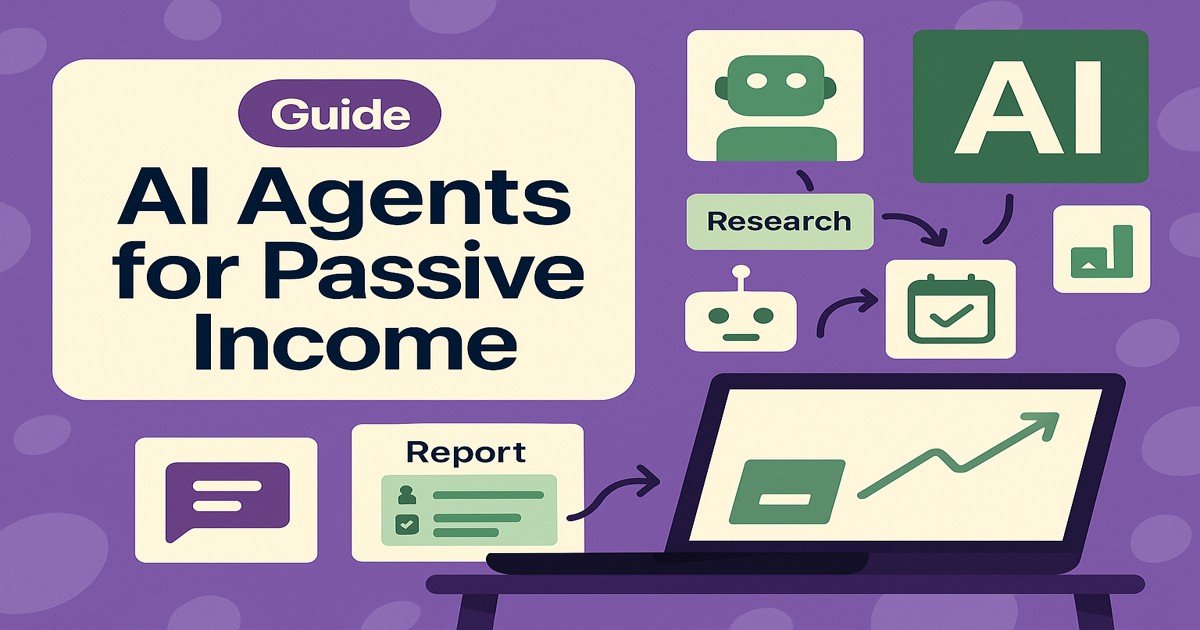
AI agents are goal-driven systems that turn an objective into a plan, call approved tools (APIs, spreadsheets, CMS, CRM), store working memory, and iterate until they hit success criteria. Unlike one-off prompts, agents persist state, reference policies, and hand off tasks to sub-agents (e.g., “researcher,” “writer,” “scheduler,” “reporter”).
- Planner: Breaks a goal into steps with acceptance criteria.
- Tooling layer: Whitelisted actions (files, analytics, CMS, email, calendar).
- Memory: Brand voice, product facts, previous outputs, do/don’t rules.
- Guardrails: Rate limits, domain restrictions, human checkpoints.
Editorial policy: We don’t promote specific products without permission/affiliation. We focus on capabilities and best practices so you can use any compliant platform.
Building Agents (Design, Tools & Guardrails)
Start with one well-defined outcome (e.g., “publish 3 internal-link SEO updates weekly” or “compile a weekly price/stock report”). Add capabilities gradually and keep humans in the loop for anything public or costly.
- Scope: Define allowed actions and prohibited behaviors (e.g., read-only analytics; no outbound email without approval).
- Tools catalog: Spreadsheet for data, CMS for content, CRM for leads, storage for assets.
- Checkpoints: “Pause for review” before publishing, spending, or messaging.
- Versioning: Store prompt chains, policies, and tool configs in version control.
- Telemetry: Log every step (inputs/outputs, tool calls, errors, approvals).
Earning Models (Where Money Comes From)
- Content sites: Agents refresh articles, schedule posts, update internal links, and compile briefs — monetized via ads, affiliates, and digital products.
- Lead generation: Agents research companies, enrich contacts, draft tailored messages for human approval, and maintain outreach queues — monetized via referrals or booked services.
- E-commerce ops: Agents update listings, monitor competitor prices, summarize reviews, and maintain “back-in-stock” notices — monetized via higher conversion and dynamic pricing.
- Micro-products: Agents draft templates/checklists, validate quality, package, and upload — monetized through marketplaces and newsletters.
- Analytics digests: Agents pull KPIs and write insights — monetized via paid weekly reports or client retainers.
Operations Stack (Logs, QA, Approvals)
Treat agents like junior assistants: they generate drafts and options; you approve. Quality rises when you implement a lightweight but consistent operating system.
- QA checklists: Accuracy, tone, links, compliance notes, duplicate checks.
- Human-in-the-loop: Approvals required for public posts, spends, pricing changes, emails.
- Rollback: Keep versioned drafts and “undo” steps for safe iteration.
- Weekly review: Look at task success rates, time saved, errors, and ROI.
Risk Management & Compliance
- Data & keys: Environment variables, least-privilege roles, no hard-coding secrets.
- Policy alignment: Respect robots.txt, API terms, privacy laws, and ad/affiliate disclosures.
- Financial actions: Human approval for purchases, trades, or pricing edits.
- Content safety: Plagiarism scans, source citations, and hallucination spot-checks.
- Auditability: Immutable logs for client reporting and incident reviews.
Bottom line: Agents multiply output, but your policies and reviews protect the brand and income.
FAQ: AI Agents & Passive Income
Can agents really run a business on their own?
No. Think of them as process accelerators. They do repeatable steps, while you set goals, approve public or financial actions, and refine strategy.
What’s the fastest place to start?
Pick one narrow workflow (weekly content refreshes, price tracking, or lead list enrichment) and add guardrails plus approvals. Nail one workflow, then expand.
How do I measure ROI?
Track tasks completed per week, hours saved, revenue per task, and error rates. Set a simple baseline, then compare after 30 days.
Do I need to code?
No. Many no-code/low-code stacks let you chain steps, call APIs, and log outputs. Coding helps at scale but is not required to begin.
Key Takeaways
- Start with one narrow workflow and strict guardrails.
- Monetization comes from systems: content, leads, ops, analytics.
- Human approvals + logs keep quality, safety, and trust high.
Next Steps (Start Small)
- Choose one income workflow (content refresh, lead enrichment, price monitor).
- Whitelist tools, add “pause for review,” and log every action.
- Run a 2-week pilot, then expand only what clearly saves time or earns money.
Pro Tip & Community
👉👉 Pro Tip: Treat your data like a digital asset. Start small, diversify platforms, and prioritize privacy settings over headline payouts.
🔗 Join our Facebook community ❤️
and the StackTricks Hangout group 💬 to share experiences and vetted platforms.