How to Retire Early with the FIRE Strategy in 2025
A practical, numbers-first playbook for Financial Independence, Retire Early (FIRE): how it works, what’s changed in today’s economy, the savings rates that actually move the needle, and the investment stack that lets your money compound while you sleep.
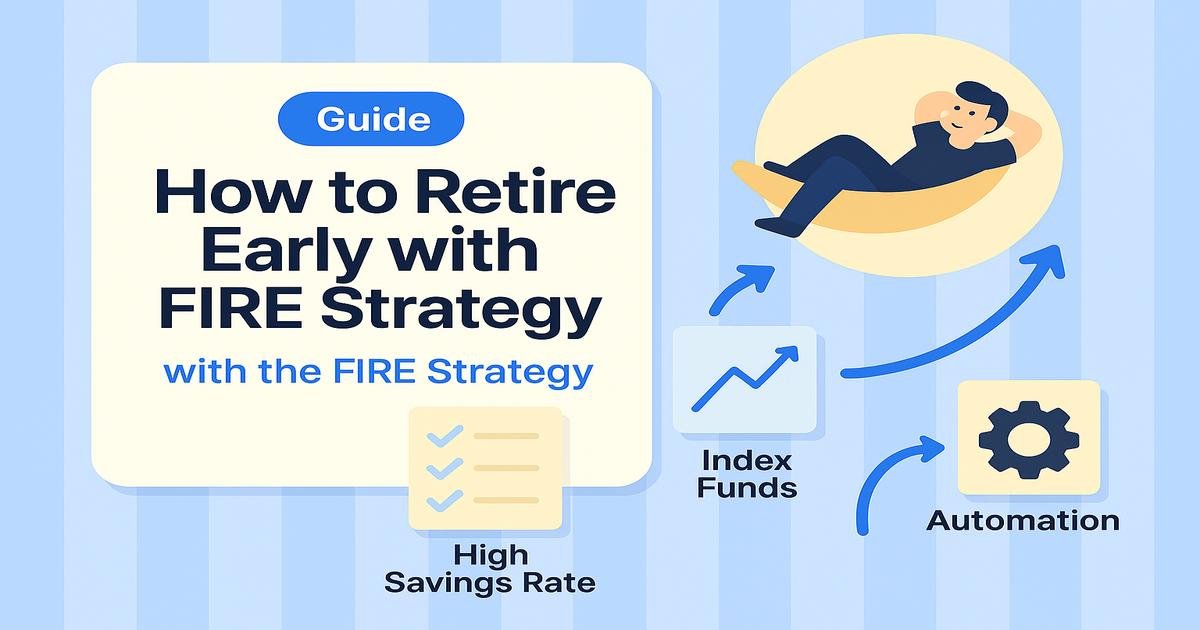
What is FIRE
FIRE means accumulating enough invested assets so that a sustainable withdrawal (often 3.5–4% of your portfolio per year) covers your living expenses—giving you work optionality decades earlier than the traditional retirement age.
- Lean FIRE: Lower annual spend; faster to target, tighter lifestyle.
- Fat FIRE: Higher annual spend; slower to target, more comfort.
- Coast FIRE: Save aggressively early; stop adding later and “coast” on compounding.
- Barista FIRE: Semi-retire with part-time income to reduce withdrawals.
The 2025 Economy & FIRE
Inflation cycles, higher-for-longer rates, and volatile markets change tactics—not the math. FIRE still hinges on two levers you control: your savings rate and time in the market. Build buffers for inflation, keep expenses flexible, and use tax-advantaged accounts before taxable.
- Inflation hedge: Prefer productive assets (broad equities, real estate funds) over idle cash beyond your emergency fund.
- Rate-aware cash: Keep 3–6 months in high-yield accounts/short-term bills for psychological safety and opportunity.
- Sequence risk: For early retirees, hold a 2–3 year “cash/bond runway” to avoid selling stocks in down years.
Saving Rate Goals
Your savings rate determines your time-to-FI. As a rule of thumb, the higher your savings rate (of gross income), the faster you can retire:
| Savings Rate | Approx. Years to FI* | Notes |
|---|---|---|
| 20% | ~30–35 years | Traditional retirement timeline |
| 40% | ~20–22 years | Achievable with lifestyle design |
| 60% | ~10–12 years | Classic FIRE pace |
| 70%+ | ~7–9 years | Requires high income + low spend |
*Assumes reasonable market returns, stable spending, and compounding.
- Cut Big Three: Housing, transport, food—optimize these before latte-level tweaks.
- Income stack: Add a niche side income (freelance/affiliate/templates) to accelerate savings rate.
- Annual spend target: FI number ≈
annual expenses × 25(for a 4% starting withdrawal); use 28–33× for more conservative plans.
Investment Strategies
Keep it simple, low-cost, and globally diversified. Most FIRE portfolios revolve around broad stock index funds with a measured bond/cash sleeve for volatility and withdrawal smoothing.
- Core: Low-cost total-market or world equity index funds/ETFs (primary growth engine).
- Stability sleeve: Short/intermediate bond funds + cash equivalents for 2–3 years of spend.
- Geo diversification: Avoid home-country concentration with global or ex-home allocations.
- Tax placement: Put bonds in tax-advantaged, equities in taxable (general guideline; verify locally).
- Rebalancing: Annual or threshold-based to maintain risk, ideally via new contributions.
- Safe withdrawal: Start at 3.5–4% with guardrails (reduce in bad years, increase in strong years).
Automation Tools
- Pay-yourself-first: Automate transfers on payday to investment and high-yield cash accounts.
- Auto-invest: Set recurring buys in core ETFs; avoid timing traps.
- Rules & alerts: Low-balance, bill-due, and subscription alerts reduce “leakage.”
- Budget automations: Categorization rules + weekly 10-minute reviews keep you on target.
- Tax automations: Auto-harvest losses/gains where legal; automate contributions to tax-advantaged accounts.
Success Stories (Patterns That Repeat)
- Dual flywheel: One partner maximizes stable income; the other builds scalable side income → savings rate jumps 10–30 pts.
- Geo-arbitrage: Temporary move to lower-cost region for 2–4 years to turbocharge savings.
- Career stacking: Skill pivots (data, product, cloud, UX) add +30–100% income within 12–24 months.
- Housing hacks: House-hack or downsize; invest equity difference into broad index funds.
FAQ
How much do I need to retire early?
Start with your annual spend. A common target is 25× expenses (4% rule). Prefer a tighter range like 28–33× for additional margin.
Is 4% still safe?
As a starting point with guardrails, it can be. Many FIRE retirees use 3.5–4% initially and adjust withdrawals with markets (raise in strong years, trim in weak years).
What if markets crash early in retirement?
That’s sequence-of-returns risk. Hold 2–3 years of living expenses in cash/bonds and cut discretionary spending temporarily to avoid selling equities at lows.
Do I need to give up everything fun?
No. Focus on the big levers (housing, transport, food) and keep a modest “fun” line. Sustainability beats perfection.
Key Takeaways
- FIRE is a math problem: higher savings rate + time in diversified low-cost funds.
- Inflation and rates shift tactics, not principles—keep a cash/bond runway.
- Automate contributions and budgeting to remove willpower from the system.
- Use guardrails on withdrawals; longevity risk favors conservative starts.
Next Steps (10-Minute Plan)
- Compute your annual spend and a FI number (25–33× expenses).
- Automate a weekly or payday investment into a broad, low-cost index ETF.
- Cut one Big-Three cost by 10–20% and redirect savings to investments.
- Build a 3–6 month cash buffer; aim for a 2–3 year runway before retiring.