How to Monetize Your Data Using AI
Your everyday data—purchase history, fitness stats, content preferences, anonymized browsing patterns—can be turned into value. This guide shows how to ethically and securely monetize data using AI-powered tools and privacy-first marketplaces, while keeping control, consent, and compliance front and center.
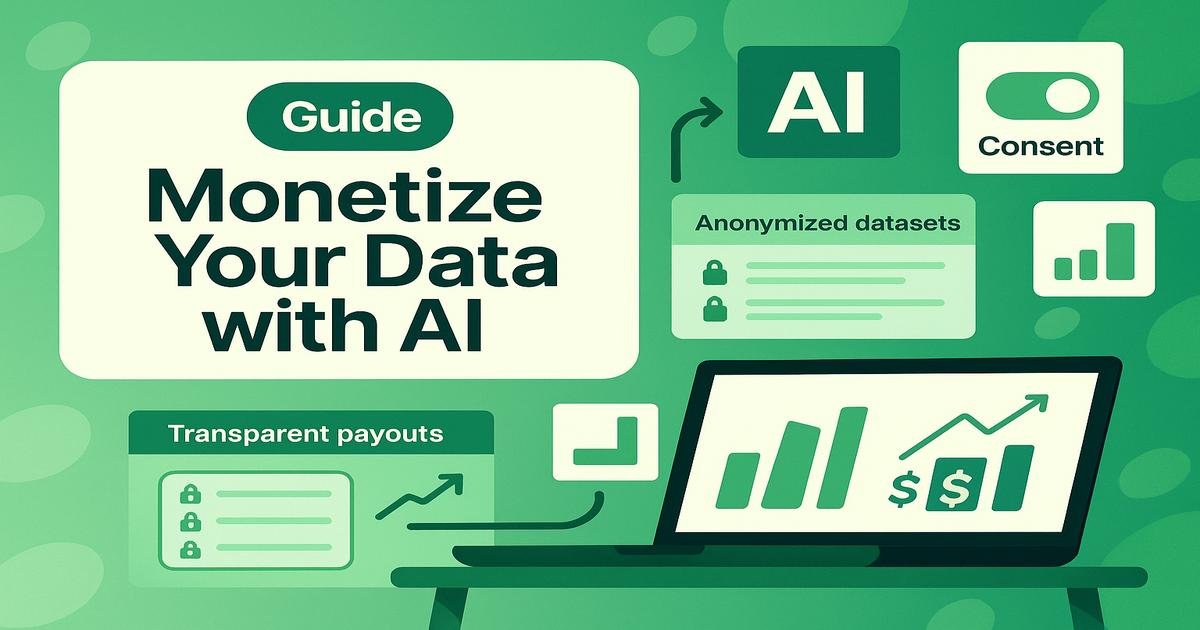
Overview
“Monetizing your data” means granting permission for aggregated, anonymized insights derived from your activity—shopping, fitness, media use, or device telemetry—to be licensed to researchers, brands, or developers. AI systems process and de-identify raw signals into patterns (e.g., “healthy recipe interest up 18% among cyclists”), which are then sold as privacy-preserving datasets or dashboards.
Editorial policy: We don’t promote specific apps without permission/affiliation. Below we focus on features, workflows, and selection criteria so you can choose safely.
Key terms: PII, GDPR, CCPA, De-ID, DP.
Data Marketplaces (How They Work)
Modern marketplaces use AI pipelines to ingest raw signals from consenting users, apply de-identification, and package insights. You typically earn via:
- One-time licenses: A buyer pays for a snapshot dataset; you receive a share.
- Revenue shares: Ongoing payouts as your data contributes to recurring dashboards.
- Reward points/credits: Exchange for gift cards or stablecoins (varies by platform & region).
What to look for:
- Explicit consent & granular controls: Opt-in by data type (health, location, purchases).
- Local processing: On-device AI or edge de-ID before upload.
- Independent audits: Public privacy audits, DP/Anon techniques documented.
- Transparent payout rules: Clear CPM/CPC or revenue-share formulas, minimums, timelines.
- Export & deletion: “Right to be forgotten” and easy data revocation.
High-Value Use Cases
- Consumer trends: Aggregated purchase categories, brand switching, seasonal demand.
- Fitness & wellness: Steps, sleep patterns, heart-rate trends (strictly anonymized).
- Content & media: What formats people watch/read, completion rates, time-of-day engagement.
- Mobility: Commute patterns, traffic heatmaps (no precise personal location sharing).
- Privacy-preserving ad testing: Cohort-level responses to creative variants.
Tip: The more consistent your data stream (e.g., weekly receipts, continuous fitness stats), the higher your potential share in longitudinal studies.
Legal Considerations (GDPR, Consent, Rights)
Under GDPR/CCPA-style regimes, you own rights to your personal data. Ethical monetization requires:
- Informed consent: Plain-language notices about purpose, buyers, retention, and withdrawal.
- Lawful basis: Usually consent; sometimes legitimate interest for research (verify details).
- Data minimization: Only collect what’s necessary; prefer on-device de-ID.
- Access, portability, deletion: Ability to download and delete your data anytime.
- Age & sensitive data: Extra safeguards for health, biometrics, or minors’ data.
This guide is educational, not legal advice. For complex cases, consult a qualified professional in your jurisdiction.
Balancing Privacy & Profit
- Share cohorts, not identities: Prefer platforms that publish only aggregated, DP-protected metrics.
- Mask locations: Use coarse geos (city/region) rather than precise GPS trails.
- Scrub metadata: Remove EXIF, order IDs, faces, voiceprints unless explicitly required and anonymized.
- Use burner emails & app sandboxes: Separate accounts and permissions from personal inboxes.
- Monitor buyers: Opt out of categories (e.g., credit scoring, invasive advertising) if offered.
Step-by-Step: Set Up, Verify & Cash Out
- Pick a compliant platform: Check consent UX, audit reports, and payout terms.
- Choose data sources: Bank receipts, fitness, content usage—enable only what you’re comfortable sharing.
- Configure privacy: Turn on de-ID, cohort sharing, DP where available. Disable precise location.
- Link a payout method: Bank/SEPA, PayPal, or crypto/stablecoin (where allowed).
- Verify & test: Submit a small data sample; confirm anonymization previews and expected earnings.
- Automate & review monthly: Keep what works, revoke what doesn’t, export logs for your records.
FAQ: Ethical Data Monetization
Is my identity truly protected?
No system is 100% risk-free. Favor platforms that use layered defenses (de-ID + differential privacy + k-anonymity) and publish independent audits.
How much can I earn?
Earnings vary by data quality, frequency, and buyer demand. Expect modest, compounding rewards rather than “get rich quick.” Longitudinal, high-quality signals tend to pay more.
Can I stop sharing later?
Yes—ethical marketplaces let you revoke consent, delete historical records (where legally possible), and halt future sharing instantly.
Do I need to pay taxes?
In many countries, rewards/payouts are taxable income. Keep statements and consult local guidance when filing.
Key Takeaways
- Monetize aggregated insights, not raw identities—use privacy-first platforms.
- Granular consent, de-ID, and right-to-delete are non-negotiable.
- Consistent, high-quality data streams earn more over time.
- Document payouts for taxes; review sharing settings monthly.
Next Steps (Start Today)
- List the data types you’re comfortable sharing (e.g., receipts, steps, media time).
- Pick one privacy-first marketplace with clear audits and try a small opt-in.
- Enable on-device anonymization, set payout method, and review earnings in 30 days.
Pro Tip & Community
👉👉 Pro Tip: Treat your data like a digital asset. Start small, diversify platforms, and prioritize privacy settings over headline payouts.
🔗 Join our Facebook community ❤️
and the StackTricks Hangout group 💬 to share experiences and vetted platforms.